
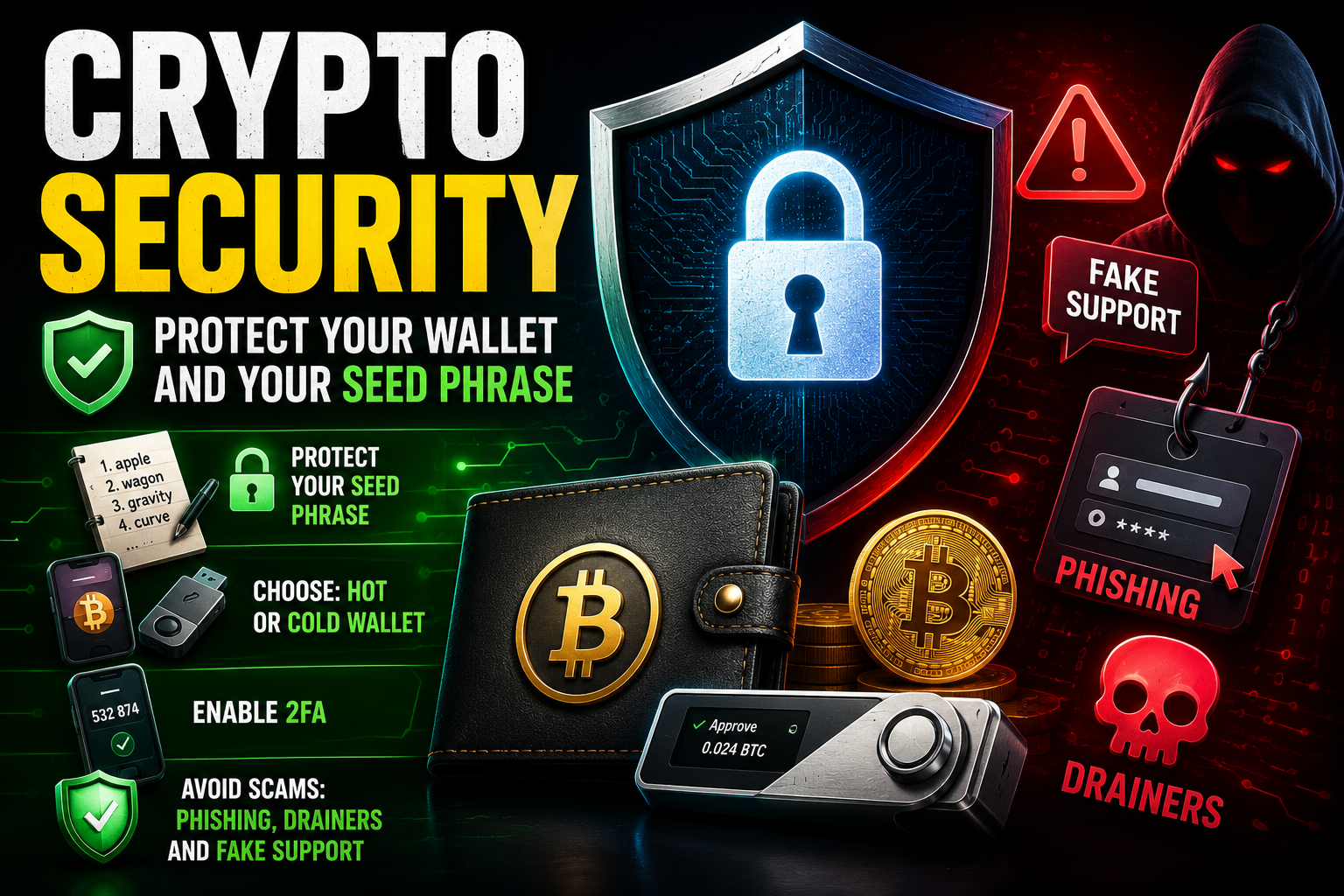
Crypto security: protect your wallet and your seed phrase
A crypto security guide: how to protect your seed phrase, choose between hot and cold wallets, enable 2FA, and avoid phishing, drainers, and fake support.
In the crypto world, you are your own bank. That's powerful and liberating, but it comes with enormous responsibility: if you lose access to your wallet or it gets stolen, there's no customer service to give your money back. That's why security isn't optional. This guide teaches you to protect your cryptocurrencies like a professional.
It's part of our guide to getting into crypto without getting scammed.
The key piece: your seed phrase
When you create a wallet, you receive a recovery phrase (seed phrase) of 12 or 24 words. Memorize this:
That phrase is your money. Whoever has it controls your crypto. Period.
That's why rule number one, the one you must never break:
NEVER share your seed phrase with ANYONE. Not with tech support, not on a website, not in a form, not with someone who claims they'll help you. No legitimate service will ever ask for it.
How to store your seed phrase
- On paper, offline: write it by hand and keep it somewhere safe. Better two copies in different places.
- Never digital: don't save it in phone notes, photos, email, or the cloud. If your device gets hacked, it's gone.
- Consider metal: for significant amounts, there are fire- and water-resistant metal plates to engrave it.
Types of wallet (and which suits you)
- Hot wallet: an app or extension connected to the internet. Convenient for day-to-day and small amounts, but more exposed.
- Cold wallet: a physical device (hardware wallet) that stores your keys offline. The safest option for significant savings.
The professional strategy: a hot wallet with a little for transactions, and a cold wallet to store the bulk. Like keeping cash in your wallet and the rest in the safe.
Essential security habits
- Enable two-factor authentication (2FA) on all your accounts, preferably with an authenticator app rather than SMS.
- Always verify addresses: before sending, check the first and last characters. There's malware that swaps the copied address.
- Distrust links: access your exchange by typing the address yourself, not from links in emails or messages.
- Be careful what you sign: when connecting your wallet to websites (DeFi, airdrops), review what permissions you grant. A malicious signature can drain you.
- Use a secondary wallet to experiment with new projects or airdrops, never your main one.
The scams that target your wallet
- Phishing: cloned websites or emails that imitate the official ones to steal your keys.
- Fake support: someone messages you "from the team" and asks for your seed phrase to "fix your problem."
- Fake apps: applications that imitate well-known wallets. Download only from official sources.
- Drainers: websites that, when you connect your wallet and sign, empty it. That's why reviewing permissions matters.
What to do if you think you've been compromised
Act fast: if you still have access, move your funds to a new, secure wallet (with a seed phrase that has never been on the internet). Revoke the permissions you've granted to websites. And learn from it without guilt: it happens to many people; what matters is reacting.
Conclusion
Crypto security comes down to a few habits that, once internalized, protect you from the vast majority of attacks. The seed phrase kept safe and offline, a hardware wallet for what matters, 2FA on everything, and a healthy distrust of rushes and links. With that, you're playing with an edge.
Want serious training on Web3 and security, without empty jargon? At MAGUITECH we teach technology responsibly. Let's talk.
Did you find this article useful?
Talk to MAGUITECH